Namib Desert · Namibia
Kolmanskop: The Diamond Boomtown Being Swallowed by the Desert
Once a glittering German colonial town built on diamond wealth, Kolmanskop was abandoned by the 1950s and is now slowly being reclaimed by the encroaching sand dunes of the Namib Desert.

In 1908, a railway worker named Zacharias Lewala found a diamond glinting in the sand near a rail line in what was then German South-West Africa, triggering a diamond rush that transformed a barren patch of Namib Desert into one of the wealthiest towns in Africa. Kolmanskop rose almost overnight, complete with grand Bavarian-style villas, a ballroom, a casino, a theater, a school, a hospital equipped with the continent's first X-ray machine, and even the southern hemisphere's first tram system, all built to serve a population of a few hundred German colonists and diamond company employees along with a larger workforce of laborers. Yet as diamond yields declined and richer deposits were discovered farther south near the Orange River in the 1920s, the town's fortunes reversed. By 1956, the last residents departed, and the surrounding dunes have been steadily consuming the abandoned buildings ever since, creating one of the world's most photographed ghost towns.
A Diamond Discovery Sparks a Boom
In April 1908, Zacharias Lewala, a railway worker of Nama and Owambo descent, discovered a diamond while working on the railway line running through the Namib Desert. His supervisor, August Stauch, recognized its significance and quickly staked claims across the surrounding area, setting off a diamond rush that drew German prospectors and colonial officials to the region within months.
The German colonial government declared much of the surrounding desert a restricted diamond area, or Sperrgebiet, a designation that remains largely in place today. Kolmanskop grew rapidly as the center of this new mining district, with diamond wealth flowing in at a stunning rate during its first two decades.
Extravagant Colonial Luxury in the Desert
For a town in one of the driest places on Earth, Kolmanskop enjoyed astonishing amenities. It featured a grand ballroom used for concerts and social functions, a casino, a school, a skittle alley, a power station, and a hospital equipped with the first X-ray unit in the southern hemisphere, used more to check workers for smuggled diamonds than for medical necessity.
Fresh water was shipped in from Cape Town, over 1,000 kilometers away, and freshwater ice was manufactured locally to cool homes and preserve food. At its peak the town's German residents lived a lifestyle comparable to affluent European towns of the era, an incongruous outpost of European luxury deep within the desert.
Decline and Abandonment
Kolmanskop's fortunes began to fade in the 1920s after richer diamond deposits were discovered farther south, near the mouth of the Orange River, prompting mining operations to shift their focus there. World War I and fluctuating diamond markets further undermined the town's economy over subsequent decades.
By the 1930s, the settlement's population had dwindled substantially, and the last residents finally left in 1956, when the mining company relocated its operations entirely to the new center at Oranjemund. The desert, no longer held back by human habitation and maintenance, quickly began reclaiming the empty buildings.
A Ghost Town Frozen in Sand
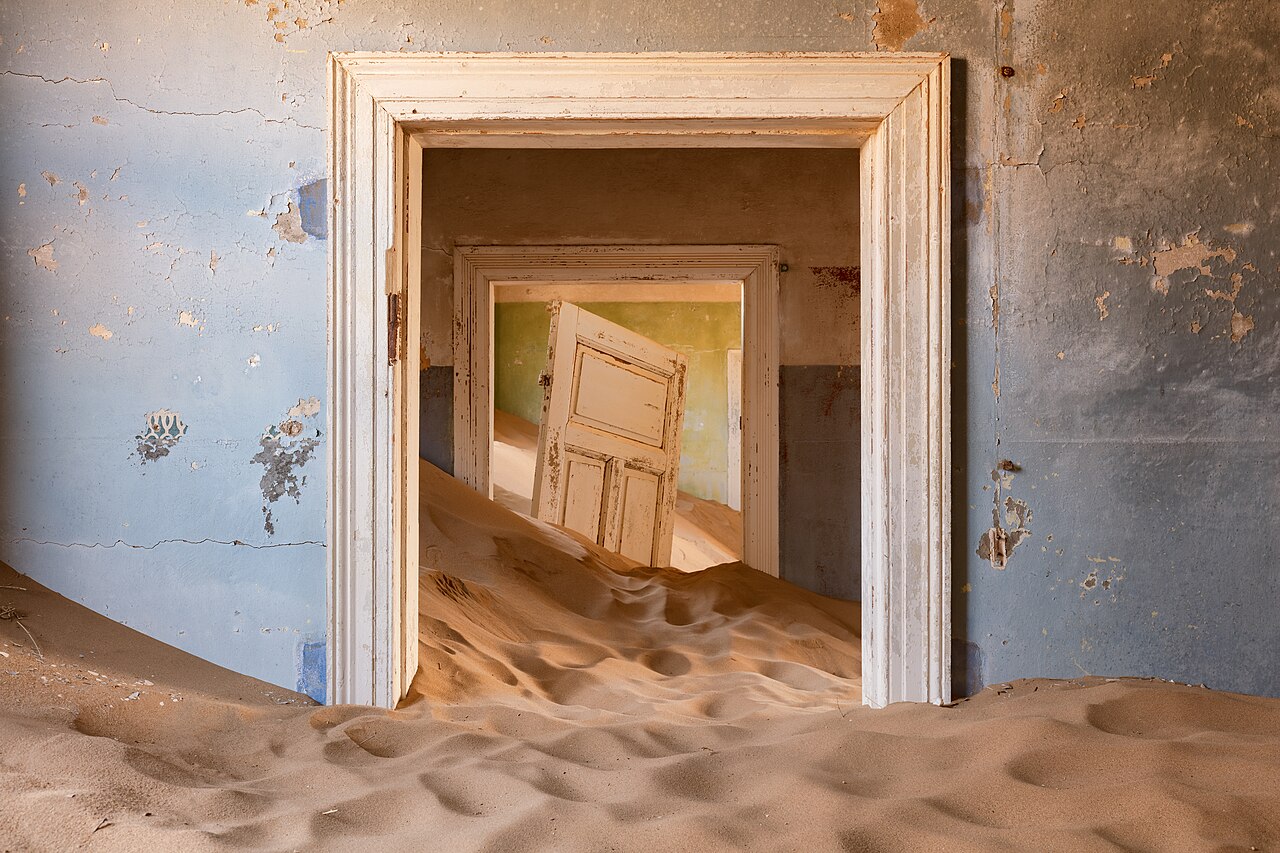
Today, Kolmanskop is one of Namibia's most visited tourist attractions, managed as a museum and heritage site by the diamond mining company Namdeb. Visitors can walk through grand houses now filled knee-deep or higher with drifting sand, their peeling wallpaper and rusted bathtubs creating an atmosphere as visually striking as it is melancholic.
Photographers from around the world travel to Kolmanskop specifically to capture the interplay of sunlight, sand, and decaying colonial architecture, and the site has become an emblem of the fleeting nature of resource-driven boomtowns everywhere.
Fun facts
- The diamond rush began in 1908 after railway worker Zacharias Lewala spotted a diamond glinting in the desert sand.
- Kolmanskop's hospital had the first X-ray machine in the southern hemisphere, largely used to detect stolen diamonds.
- Freshwater had to be shipped over 1,000 kilometers from Cape Town to supply the town.
- The town was completely abandoned by 1956 after richer diamond deposits were found further south.
- Drifting Namib Desert sand now fills many of the town's abandoned buildings up to the ceiling.
Gallery


Sources
Other interesting places
View all →


Featured lists
View all lists →


Compare cities, side by side
Choose any 2 cities →


Text on this page is original Terralocate editorial. Background facts compiled from the public sources listed above. Images via Wikimedia Commons under their respective licenses (typically CC BY-SA or public domain).