The loneliest place in the ocean
Point Nemo
The spot in the Pacific farthest from any land is so remote that astronauts orbiting overhead are sometimes the closest humans to it, which is why space agencies use it as a spacecraft graveyard.

Point Nemo, named after Jules Verne's submarine captain, is the oceanic pole of inaccessibility, the point in the ocean farthest from any land in every direction. Located in the South Pacific, it sits about 2,688 kilometers from the nearest coastlines, which belong to a handful of uninhabited islands and Antarctica. The waters around it are so nutrient-poor and remote from ocean currents that carry life that they count among the most biologically inactive regions of open ocean on the planet, essentially a marine desert. That extreme isolation from shipping lanes and human activity is exactly why space agencies including NASA, Roscosmos, and the European Space Agency chose the surrounding waters as the preferred crash site for decommissioned satellites, cargo ships, and space station modules reentering the atmosphere. Over the decades more than 250 pieces of space debris have been deliberately sunk there, earning the area the nickname the spacecraft cemetery. The Russian space station Mir met its end there in 2001, and the International Space Station itself is slated for a similar deorbit into these waters when it is retired.
Finding the point
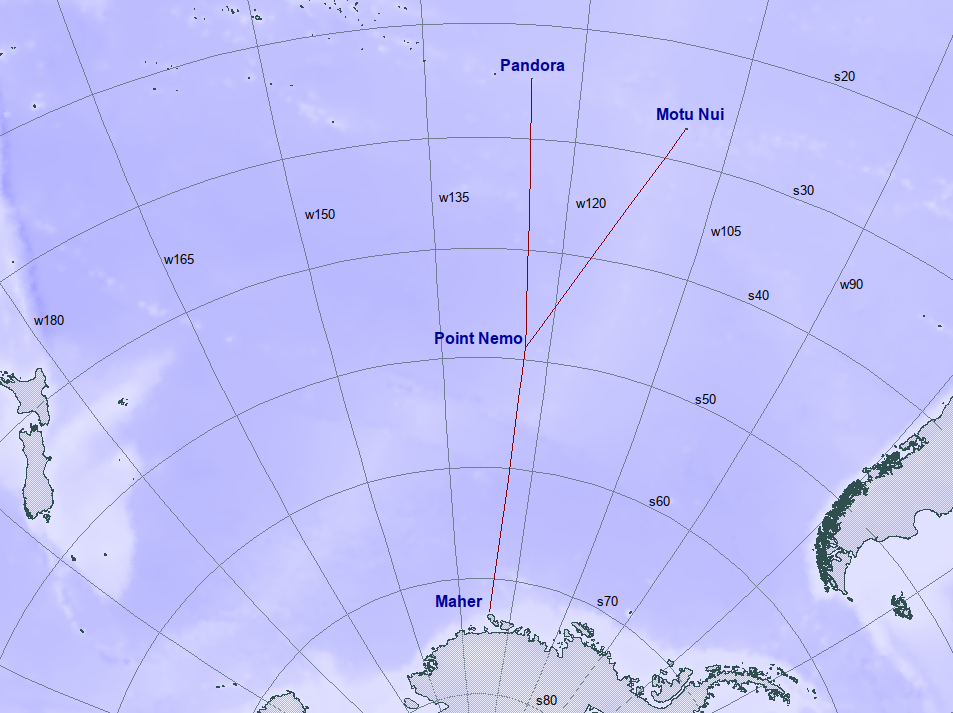
Point Nemo was calculated in 1992 by Croatian-Canadian survey engineer Hrvoje Lukatela using geospatial software, identifying the exact coordinates equidistant from three landmasses: Ducie Island, Motu Nui near Easter Island, and Maher Island off Antarctica. The name comes from Captain Nemo of Jules Verne's Twenty Thousand Leagues Under the Sea, itself Latin for no one, fittingly descriptive of a spot devoid of any human presence.
A biological desert
The point lies within the South Pacific Gyre, a vast rotating current system that isolates the surrounding waters from nutrient-rich currents elsewhere in the ocean. Marine biologists have found this region has some of the lowest chlorophyll concentrations and lowest biological productivity of any ocean area on Earth. Because so little life congregates there, it makes an ideal location to sink hazardous space hardware without risking marine ecosystems or ship traffic.
The spacecraft cemetery
Since the 1970s, space agencies have used the region as a controlled crash zone for retired satellites, rocket stages, and cargo resupply vehicles that do not fully burn up on reentry. The Russian Mir space station was deliberately deorbited into these waters in March 2001 after fifteen years in orbit. Roughly 260 to 300 pieces of debris are estimated to rest on the seafloor nearby, and the aging International Space Station is expected to eventually join them there around the mid-2030s.
Closer to space than to people
Because Point Nemo is so far from any inhabited coastline, the closest humans to it are often astronauts aboard the International Space Station, which orbits at an altitude of about 400 kilometers, closer than the nearest populated landmass over 2,600 kilometers away. This trivia detail has made Point Nemo a favorite factoid for illustrating just how vast and empty the Pacific Ocean truly is.
Fun facts
- Point Nemo is about 2,688 kilometers from the nearest land in any direction.
- Astronauts on the ISS are sometimes literally the closest people to Point Nemo.
- More than 250 pieces of spacecraft debris rest on the ocean floor near the site.
- The Mir space station was deliberately crashed there in 2001.
- It is named after Captain Nemo, whose name means no one in Latin.
Gallery


Sources
Other interesting places
View all →


Featured lists
View all lists →


Compare cities, side by side
Choose any 2 cities →


Text on this page is original Terralocate editorial. Background facts compiled from the public sources listed above. Images via Wikimedia Commons under their respective licenses (typically CC BY-SA or public domain).